I just had a very good question from one of my REM 100 students:
"For the term paper are we allowed to use newspaper articles or should we stay clear of them?"
I have often wondered when to use popular sources in papers? The answer is basically, depends on the source's stake in the material and the audience in question.
"To understand this difference [b/w scholarly and popular sources], it may help to recognize that when you write for a departmental class, you are writing for an audience more expert than the common reader. When writing about Republican and Democratic voting patterns on stem cells, science reports from a general interest magazine like Newsweek might be considered sufficiently authoritative. But when you write about stem cells for a Biomedical Engineering class, your teachers and classmates are considered more expert than the average non-scientist reader. For this audience, your sources must have stronger science credentials, must generally be working scientists, not journalists.
Newspapers are not as easy to classify as other sources. Newspapers are not scholarly sources, but some would not properly be termed popular, either. Every source must be questioned for its stake in the material. The New York Post is known for its conservative political bias, for instance, and for its high opinions of Fox television shows (owned by the same parent company). You might be able to trust its sports coverage, but it would not be considered a neutral source for political news. But some newspapers have developed a national or even worldwide reputation for fairness and accuracy. The New York Times, The Washington Post, and The London Guardian are a few examples. On issues of fact, major mainstream magazines such as Newsweek and Time are also generally reliable.
Finally, it’s worth noting that many Internet sources are less reliable than print sources."
-Yale Writing Center
Wednesday, November 10, 2010

Wednesday, November 3, 2010
Environmental versus Natural Resources, a worthy distinction?
Maybe not a "worthy" distinction, but one that has come up more than once when dealing in environmental economics.
"Environmental economics was once distinct from resource economics. Natural resource economics as a subfield began when the main concern of researchers was the optimal commercial exploitation of natural resource stocks. But resource managers and policy-makers eventually began to pay attention to the broader importance of natural resources (e.g. values of fish and trees beyond just their commercial exploitation;, externalities associated with mining). It is now difficult to distinguish "environmental" and "natural resource" economics as separate fields as the two became associated with sustainability."
-Wikipedia
So I work for a department entitled: Resource and Environmental Management. Environmental management refers to the management of interaction by the modern human societies with, and impact upon the environment. While resource managment refers to the management of natural resources such as land, water, soil, plants and animals, with a particular focus on how management affects the quality of life for both present and future generations. This I think is a worthwile distinction. Now about the management part............
"Environmental economics was once distinct from resource economics. Natural resource economics as a subfield began when the main concern of researchers was the optimal commercial exploitation of natural resource stocks. But resource managers and policy-makers eventually began to pay attention to the broader importance of natural resources (e.g. values of fish and trees beyond just their commercial exploitation;, externalities associated with mining). It is now difficult to distinguish "environmental" and "natural resource" economics as separate fields as the two became associated with sustainability."
-Wikipedia
So I work for a department entitled: Resource and Environmental Management. Environmental management refers to the management of interaction by the modern human societies with, and impact upon the environment. While resource managment refers to the management of natural resources such as land, water, soil, plants and animals, with a particular focus on how management affects the quality of life for both present and future generations. This I think is a worthwile distinction. Now about the management part............
Tuesday, November 2, 2010
Queens versus American English (analyse v. analyze)
So I continue to fail students who use the queen's English in my assignments. It's not cause I hate the queen, it's cause I thought they were wrong. Turns out there is in fact a "Canadian English" that is allowed to poach from either American or British (queen's) English.
"Canadian English should not be described as a mixture of American and British English with an insignificant number of Canadianisms added. Canadian English, like all ‘Englishes’, possesses an important characteristic, referred to as wholesale borrowing, which has allowed it to develop a very rich vocabulary. Canadians have in the past and will most likely in the future continue to borrow freely from both American and British English; however, once a lexeme is borrowed, it has the possibility to evolve differently. In other words, Canadians appropriate it to suit their needs. "
And when it comes to the analyse v. analyze....
"Canadians unlike Americans have a choice in matter pertaining to spelling. Canadians can choose to spell the following words either the American or British way: center/centre, practice/practise[5], analyze/analyse, color/colour. However, consistency must govern usage. Thus, if a Canadian in a formal paper chooses to use British spelling, he or she must take care to use all British suffixes where there are common suffixes to chose from. This is the advice given by the Canadian Oxford English Dictionary in the Style Guide section under Appendices. The aforementioned dictionary is considered, and for good reason, the authority on matters pertaining to style."
-Canadian English
So bottom line: Canada has its own English. It's just either British or American English, but not both.
"Canadian English should not be described as a mixture of American and British English with an insignificant number of Canadianisms added. Canadian English, like all ‘Englishes’, possesses an important characteristic, referred to as wholesale borrowing, which has allowed it to develop a very rich vocabulary. Canadians have in the past and will most likely in the future continue to borrow freely from both American and British English; however, once a lexeme is borrowed, it has the possibility to evolve differently. In other words, Canadians appropriate it to suit their needs. "
And when it comes to the analyse v. analyze....
"Canadians unlike Americans have a choice in matter pertaining to spelling. Canadians can choose to spell the following words either the American or British way: center/centre, practice/practise[5], analyze/analyse, color/colour. However, consistency must govern usage. Thus, if a Canadian in a formal paper chooses to use British spelling, he or she must take care to use all British suffixes where there are common suffixes to chose from. This is the advice given by the Canadian Oxford English Dictionary in the Style Guide section under Appendices. The aforementioned dictionary is considered, and for good reason, the authority on matters pertaining to style."
-Canadian English
So bottom line: Canada has its own English. It's just either British or American English, but not both.
Thursday, October 28, 2010
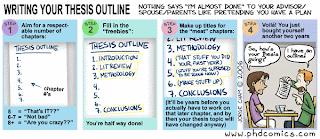
The making of a new thesis
Probably the worst part of going a new direction in your thesis is having to outline and come up with a proposal of something that is going to change 100 times more before you go through your comprehensive exam and get it approved, only to change 50 more times before you actually get near the formal writing of the thesis. So excuse me if I dont take outlining and the proposal with that much gravity. I suppose I should go the way of PhD comics....

Tuesday, October 26, 2010
Informatics*
* information science: the sciences concerned with gathering, manipulating, storing, retrieving, and classifying recorded information
-Wordweb
i.e. wicked cool visuals.
One of my supervisors said something that really stuck with me
"I pretty much write my manuscripts [journal articles] around a few good figures"
If you take a look at typical science article you see 1 or 2 figures, each displaying 5-10 sets of data. Clearly this is quite a task. It's no wonder why making figures takes more time than the actual writing (or it seems -there probably is a sub-thesis social survey there).
So there is the big question: How do I jam as many data sets as possible into journal figures while still making it visually appealing?
Edward Tufte and Informatics attempts to answer this question.
Informatics seems like something apart for science. An afterthought. Some visual designers with all the data at their fingertips and a bunch of fancy proprietary software like tableau and time. So how does the scientist dable in this informatics game? Edward Tufte has the answer:
"Copy the great architects" -Edward Tufte
Here is a cool blog on infographics
Edward Tufte's books, posters and works
Of course my favorite infographic:

More on visuals in a later post.
-Wordweb
i.e. wicked cool visuals.
One of my supervisors said something that really stuck with me
"I pretty much write my manuscripts [journal articles] around a few good figures"
If you take a look at typical science article you see 1 or 2 figures, each displaying 5-10 sets of data. Clearly this is quite a task. It's no wonder why making figures takes more time than the actual writing (or it seems -there probably is a sub-thesis social survey there).
So there is the big question: How do I jam as many data sets as possible into journal figures while still making it visually appealing?
Edward Tufte and Informatics attempts to answer this question.
Informatics seems like something apart for science. An afterthought. Some visual designers with all the data at their fingertips and a bunch of fancy proprietary software like tableau and time. So how does the scientist dable in this informatics game? Edward Tufte has the answer:
"Copy the great architects" -Edward Tufte
Here is a cool blog on infographics
Edward Tufte's books, posters and works
Of course my favorite infographic:

More on visuals in a later post.
Monday, October 25, 2010
50 REM 100 LCAs
That was a lot of grading. But I did it in one day. 7 pages of poorly cited "scientific" research. Here is my #1 complaint. AMBIGUITY.
ambiguous - having more than one possible meaning; "ambiguous words"; "frustrated by ambiguous instructions, the parents were unable to assemble the toy"
-Wordweb
Here is a list of the most common ambiguous words in the first years writing by category:
Vague Words:
Normally
Generally
Implied Certainty:
Always
Never
All
Every
Comparatives:
Highest
Latest
words ending in "or" or "est"
Words that cannot be qualified:
Efficient
Normal
Faster
Adequate
It was a gold mine......a gold mine of arbitrary
ambiguous - having more than one possible meaning; "ambiguous words"; "frustrated by ambiguous instructions, the parents were unable to assemble the toy"
-Wordweb
Here is a list of the most common ambiguous words in the first years writing by category:
Vague Words:
Normally
Generally
Implied Certainty:
Always
Never
All
Every
Comparatives:
Highest
Latest
words ending in "or" or "est"
Words that cannot be qualified:
Efficient
Normal
Faster
Adequate
It was a gold mine......a gold mine of arbitrary
Monday, October 18, 2010
How to use a semicolon
Don't. That used to be my tact on semicolons. Why bother getting it wrong, I will just craft my sentence(s) in a fashion that does not lend itself to the old crotchety punctuation that I only use to make winking smiley faces in texts.
Well that is a pretty ignorant thing to do. My colleagues us "semis" and I always assume they are using them in the correct fashion. To that I say no more! I have ESL colleagues that depend on my to make sure their English is correct. For example:
"The nature of penalty under s.75.21 as a surcharge on stumpage also support absolute liability; there is no defence of due diligence in respect of stumpage payable on the excess volume s.103 of the Forest act."
Is this correct? I need some help.
1. Use a semicolon between closely related independent clauses not joined a coordinating conjunction. When related independent clauses appear in a sentence they should usually be linked together with a coordinating conjunction (and, but, or, nor, for, yet, so). These words signal that there is a relationship between the two clauses. If the clauses are related and if the relationship between them is clear without a conjunction, you can use a semicolon instead.
* I got into an accident; the car was damaged badly.
* I remember the incident well; it happened in 1983.
Semicolons are often used to correct comma splices, which is what happens when we connect two independent clauses with a comma when there is no coordinating conjunction:
* I was late to class today, there was no parking.
This sentence contains a comma splice. While the instinct in correcting comma splices is to use a semicolon here, simply adding a coordinating conjunction would correct the comma splice:
* I was late to class today because there was no parking.
One common mistake is to use words like “however” or “therefore” as coordinating conjunctions. However, they are not. When connecting two independent clauses with a comma and a word like “however” or “therefore,” you can either divide the sentence into two sentences, or use a semicolon, which can be used to connect two independent clauses without a coordinating conjunction.
If you are unsure whether to use a comma or semicolon, check if both sides are independent clauses, or what can stand on their own as sentences. If both sides are independent clauses, you either need a semicolon or a coordinating conjunction. If only one side is an independent clause, and the other is a dependent clauses, use a comma.
If you are unsure whether to use a semicolon or period, think about why you want to join the two ideas together in the first place: should they be in the same sentence or in separate sentences?
2. Use a semicolon between items in a series of items that already contain commas:
* Some of her favorite deserts are chocolate cake, the kind with cherries on top; banana splits, without any nuts; and rice pudding, but only if it is made without raisins.
-University of Maryland
So taking my new-found knowledge I think my colleague was attempting to fix a comma splice with a semicolon. I would change the sentence to read (also correcting the spelling):
"The nature of penalty under s.75.21 as a surcharge on stumpage also support absolute liability because there is no defense of due diligence in respect of stumpage payable on the excess volume s.103 of the Forest Act."
Straight up. Tell me I'm wrong.
Well that is a pretty ignorant thing to do. My colleagues us "semis" and I always assume they are using them in the correct fashion. To that I say no more! I have ESL colleagues that depend on my to make sure their English is correct. For example:
"The nature of penalty under s.75.21 as a surcharge on stumpage also support absolute liability; there is no defence of due diligence in respect of stumpage payable on the excess volume s.103 of the Forest act."
Is this correct? I need some help.
1. Use a semicolon between closely related independent clauses not joined a coordinating conjunction. When related independent clauses appear in a sentence they should usually be linked together with a coordinating conjunction (and, but, or, nor, for, yet, so). These words signal that there is a relationship between the two clauses. If the clauses are related and if the relationship between them is clear without a conjunction, you can use a semicolon instead.
* I got into an accident; the car was damaged badly.
* I remember the incident well; it happened in 1983.
Semicolons are often used to correct comma splices, which is what happens when we connect two independent clauses with a comma when there is no coordinating conjunction:
* I was late to class today, there was no parking.
This sentence contains a comma splice. While the instinct in correcting comma splices is to use a semicolon here, simply adding a coordinating conjunction would correct the comma splice:
* I was late to class today because there was no parking.
One common mistake is to use words like “however” or “therefore” as coordinating conjunctions. However, they are not. When connecting two independent clauses with a comma and a word like “however” or “therefore,” you can either divide the sentence into two sentences, or use a semicolon, which can be used to connect two independent clauses without a coordinating conjunction.
If you are unsure whether to use a comma or semicolon, check if both sides are independent clauses, or what can stand on their own as sentences. If both sides are independent clauses, you either need a semicolon or a coordinating conjunction. If only one side is an independent clause, and the other is a dependent clauses, use a comma.
If you are unsure whether to use a semicolon or period, think about why you want to join the two ideas together in the first place: should they be in the same sentence or in separate sentences?
2. Use a semicolon between items in a series of items that already contain commas:
* Some of her favorite deserts are chocolate cake, the kind with cherries on top; banana splits, without any nuts; and rice pudding, but only if it is made without raisins.
-University of Maryland
So taking my new-found knowledge I think my colleague was attempting to fix a comma splice with a semicolon. I would change the sentence to read (also correcting the spelling):
"The nature of penalty under s.75.21 as a surcharge on stumpage also support absolute liability because there is no defense of due diligence in respect of stumpage payable on the excess volume s.103 of the Forest Act."
Straight up. Tell me I'm wrong.
Subscribe to:
Posts (Atom)